
Emotional Intelligence at Work: Six Ways to Build It in Your Team
Let me ask you something. What do you think separates your top performers from everyone else? Is it their degree? Their technical skills? Their years of experience?
Harvard Business School studied this exact question, and the answer might surprise you. According to research on emotional intelligence in the workplace, 90% of top performers, the people who consistently outperform their peers, get promoted faster, and deliver results under pressure, share one specific trait. Not a high IQ. Not an elite education. Not more hours in the office.
Now flip that around. If 90% of your top performers have high emotional intelligence, what does that tell you about the people who are not performing? And what does it tell you about the leaders who are supposed to bring out the best in them?
Those questions are exactly what I want to answer here. My name is Bryan Schaefer. I am a leadership coach and Certified Alignment Practitioner with over 30 years of experience in leadership development and organizational training. I am going to show you exactly what emotional intelligence is, why it is the most powerful and most underestimated force in any workplace, and six specific ways to build it in yourself and across your team.
Pay close attention to strategy four, because it is the one that separates good leaders from the leaders people never want to leave.
What Emotional Intelligence Actually Is
Before we go any further, let's define what emotional intelligence actually is, because it gets misunderstood constantly.
Emotional intelligence is not about being nice. It is not about being warm, agreeable, or soft. And it is absolutely not about suppressing how you feel.
Emotional intelligence, in the context of organizational behaviour and professional life, is the ability to recognize, understand, and manage your own emotions, and to recognize and respond effectively to the emotions of the people around you.
Let's also clear up the terms. Emotional intelligence is also called EI or EQ, and these terms can be used interchangeably. EQ is simply a measure of emotional intelligence, just as IQ is a measure of intelligence. So when someone has a high EQ, in this context, that is a very good thing.
Why Emotional Intelligence Matters
Before we get to the strategies, it is worth understanding just how much is riding on this, because the numbers are bigger than most leaders realize.
Research from the Six Seconds Emotional Intelligence Institute found that a leader's EQ accounts for up to 70% of the variation in team engagement. Seventy percent. That means the single biggest factor in whether your people are engaged or checked out is not the market, the product, or the pay. It is the emotional intelligence of the person leading them.
And disengagement is expensive. Gallup research reported by Six Seconds estimates that US businesses lose $1.8 trillion in productivity every year to disengagement. Not millions. Trillions.
On the other side of that equation, ElectroIQ's emotional intelligence statistics show that companies that prioritize emotional intelligence are 22 times more likely to be high-performing than those that do not.
So this is not a soft skill. It is one of the highest-leverage forces in your entire business. Here are six research-backed strategies to develop and apply it in your workplace.
The Six Strategies to Build Emotional Intelligence
1. Build Self-Awareness Before Anything Else
Self-awareness is the foundation of all emotional intelligence. You cannot manage what you cannot see. And the research is consistent on this point: leaders who lack self-awareness are significantly more likely to derail, not because of a lack of competence, but because of blind spots in how they behave under pressure, how they come across in high-level meetings, and how their reactions affect the people around them.
The Korn Ferry Institute, which has assessed thousands of senior leaders globally, found that leaders with high self-awareness consistently outperform those without it in virtually every leadership dimension: decision-making, communication, adaptability, and team performance.
Here is the uncomfortable truth about self-awareness: most leaders think they already have it. Research shows that while 95% of people believe they are self-aware, only about 10 to 15% actually are. That is not a character flaw; it is a skill gap. And like any skill gap, it can be closed.
What to do: Start with one daily question. At the end of every workday, ask yourself: What emotion was driving me in the most important conversation I had today, and did that emotion serve the other person or me? Write it down. One sentence. That 30-second habit, done consistently, builds more self-awareness than most leadership training programs.
Before you can lead others well, you have to understand what is actually happening inside yourself first.
2. Use Emotional Intelligence as a Hiring Filter, Not an Afterthought
One of the most impactful places emotional intelligence shows up in business is in who you choose to bring into the organization, especially who you put in leadership roles.
Research shows that 59% of employers say they would not hire someone with a high IQ but low emotional intelligence, and 75% say they are more likely to promote a high-EQ employee over a high-IQ one with lower EQ, according to these statistics on emotional intelligence in hiring.
Why? Because technical skill gets someone through the door. Emotional intelligence determines whether they will build relationships, navigate pressure, drive a team, and stay when things get hard.
The most compelling business case I have seen for this is L'Oréal. The cosmetics company began selecting sales agents based on emotional competencies, and the results were extraordinary. According to the business case for emotional intelligence documented by the EI Consortium, the EI-selected salespeople sold an average of $91,370 more per year than colleagues hired through the traditional process. That produced a net revenue increase of over $2.5 million per year. And the same group had 63% less turnover.
What to do: Add three questions to every interview process for every role, not just leadership roles. These are behaviour-based interview questions that reveal how people actually act in real situations. Ask:
Tell me about a time you stayed calm when something went wrong.
Tell me about a time you had to deliver difficult feedback.
Tell me about a time you had to work with someone you found genuinely difficult.
What those answers tell you is worth more than the rest of the interview combined. Who you hire shapes your culture. Emotional intelligence in hiring is the single fastest way to change who you become as an organization.
3. Develop Emotional Intelligence in Your Existing Leaders
If you think emotional intelligence is something people either have or do not, research says otherwise. Emotional intelligence is not a fixed trait. It is a skill. And like any skill, it can be trained, practised, and measurably improved.
PepsiCo ran one of the most well-documented studies on what happens when you prioritize emotional intelligence at the leadership level. According to the business case for EQ from TalentSmart, when PepsiCo focused on selecting and developing executives with high EQ, they saw a 10% increase in productivity, an 87% reduction in executive turnover, $3.75 million in economic value added, and an ROI on the EI program over 1,000%.
Across multiple studies, EI training programs show an average ROI of over 1,484%. That is one of the highest-returning investments any organization can make in its people. For context, the average return on leadership training is generally between 100% and 300%. EI-focused development consistently produces returns that are multiples of that.
What to do: Identify your top three to five leaders, the people with the most direct influence over your culture, and invest in their emotional intelligence development specifically. Not generic leadership training. Training focused on self-awareness, emotional regulation, social awareness, and relationship management. The return, based on the research, will exceed almost anything else you spend on development this year.
You would not let your team's technical skills go untrained. Do not let the most important leadership skill go untrained either.
4. Make Empathy a Non-Negotiable Leadership Standard
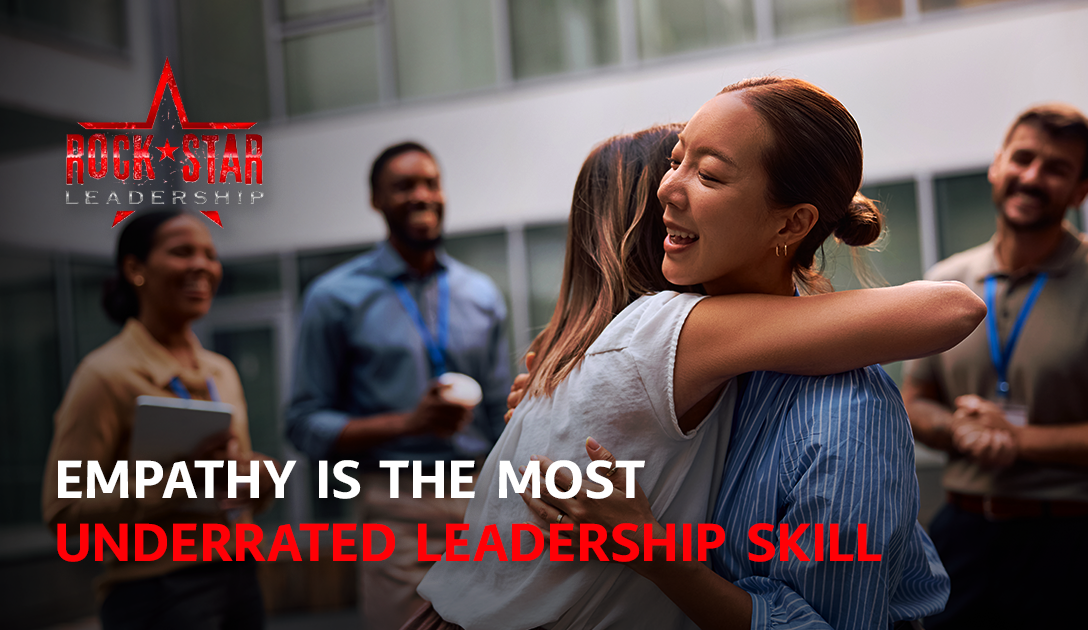
Empathy is the most underrated leadership skill in business, but it is also the most powerful. It is the engine of everything that social awareness and relationship management require. It is what allows a leader to walk into a high-level meeting and read who is actually invested, who is disengaged, who is threatened, and who needs to be brought along.
Research from Businessolver's State of Workplace Empathy study found that 76% of employees with empathetic leaders report higher engagement, and 61% report increased creativity when they feel genuinely understood. Those are not soft outcomes. Engagement and creativity are directly tied to output, quality, and innovation.
One of the keys to empathy is reading nonverbal cues, including body language, posture, and eye contact. If you pay attention to these things and really care about what the other person is communicating with their body, you can show empathy. You have heard the expression "read the room." The people who cannot read the room lack strong empathy.
Poor communication is almost always a failure of empathy: someone failed to consider how their message would land, or what the other person actually needed to hear. This connects directly to something I covered in six conflict management strategies that actually work, because the leaders who resolve conflict well are almost always the ones with the empathy to understand what is driving it in the first place.
Empathy is what closes that gap. It is what allows you to adjust how you communicate based on who you are communicating with. To know when someone needs directness and when they need reassurance. To understand what is driving someone's resistance before you try to overcome it.
What to do: Before your next difficult conversation with a team member, a client, or a partner, take 60 seconds and ask yourself: what is this person likely feeling right now, and what do they actually need from this conversation? That question does not make you softer as a leader. It makes you significantly more effective because people who feel understood are far more likely to engage, comply, collaborate, and trust.
5. Create an Environment Where Emotional Honesty Is Safe
This strategy is the one most organizations never even consider, and it is the one that determines everything else on this list.
An individual's emotional intelligence is powerful. But emotional intelligence as a cultural norm, a shared standard of how people communicate, handle tension, and treat each other when things get difficult, is transformational.
The research on psychological safety from Google's Project Aristotle found that the highest-performing teams are not the ones with the most talented individuals. They are the ones where people feel safe enough to be honest, to admit uncertainty, to challenge an idea, to say "I'm struggling" without fear of judgment or consequence. This is the same psychological safety I wrote about in "six signs of a toxic workplace" and "how to realign your team," and it turns out to be just as central to emotional intelligence as it is to culture.
What is emotional intelligence in organizational behaviour, at its most practical? It is a culture where people do not have to hide what they actually think and feel in order to be safe. Where a manager can say "I got that wrong" without losing authority. Where a team member can flag a problem without being punished for raising it.
Research cited by the American Psychological Association found that 40% of employees feel they cannot be themselves at work. That is 40% of your team performing with a filter on, holding back ideas, concerns, and contributions because the environment has not made it safe not to.
What to do: Model it yourself. The next time something goes wrong in your business, be specific and public about your own role in it. Not self-flagellation, just honest accountability: "Here is what I would do differently next time." That one act, done genuinely, does more for psychological safety than any policy or program. It tells your team that emotional honesty is safe here. And that is the foundation every high-performance culture is built on.
6. Use Emotional Intelligence to Retain Your Best People Before It's Too Late
One of the clearest expressions of the power of emotional intelligence in the workplace is in retention, and the research on this is striking.
According to retention research on emotional intelligence, workers with emotionally intelligent managers are four times less likely to leave. Not 10% less likely. Four times. And organizations that implement EI programs and interventions see a 63% reduction in employee turnover.
Think about what that means financially. SHRM estimates that replacing a single employee costs between 50% and 200% of their annual salary. If your average employee earns $60,000 and you lose five people this year, you are looking at a potential replacement cost of $300,000 to $600,000. That does not include the cultural damage from the exits, the loss of institutional knowledge, or the impact on the team left behind.
Now consider this: employees do not leave companies; they leave managers. And the research is consistent. The most common reason a high performer exits is not pay, not opportunity, not the commute. They did not feel seen, heard, or valued by their direct leader. Those needs have a name, SHUVA: Seen, Heard, Understood, Valued, and Appreciated. And meeting them is an emotional intelligence skill, not a compensation decision.
High-EQ leaders retain great people because they make people feel that working here matters, that they matter, and that their growth is genuinely invested in. People do not leave leaders who make them feel that way.
What to do: In your next one-on-one with each direct report, not a task review, not a project update, but a genuine one-on-one, ask this question: "Is there anything about your role right now that is frustrating you that we have not talked about?" Then listen. Not to fix it immediately. Just to hear it. Asking and genuinely receiving the answer is one of the highest EI moves a leader can make. And it is also one of the most effective retention tools available.
Your people will stay for pay. They will leave because of how they were treated. And they will stay for years, willingly and loyally, when they feel genuinely valued.
Take the Next Step Toward a Higher-EQ Team
Those six strategies are not a theory. They are backed by some of the most credible research in organizational psychology and business performance, from Harvard, Gallup, Google, and companies like PepsiCo and L'Oréal, which have tested these at scale and documented the results.
But I want to be direct with you: knowing this is not the same as doing it. The gap between understanding emotional intelligence and actually embedding it in how you lead, how you hire, and how your culture operates is where most organizations lose the advantage.
That is exactly what I help business owners close.
If any of this landed, and you are thinking we are not operating at this level yet, or I have leaders who are technically strong but struggling with the human side, or I want to build this kind of culture, but I do not know where to start, I want to talk to you.
I am the founder of Rockstar Leadership Training, and I have spent over 30 years helping business owners and leaders develop the emotional intelligence, alignment, and leadership skills that actually move the needle, not just in how the team feels, but in how the team performs.
I offer a free 30-minute Leadership Strategy Meeting. You tell me what is happening in your team and your leadership, and I will tell you exactly what I would focus on first. It is completely free and will give you clear, specific direction to start building a higher-EQ team. Reserve your spot here.
